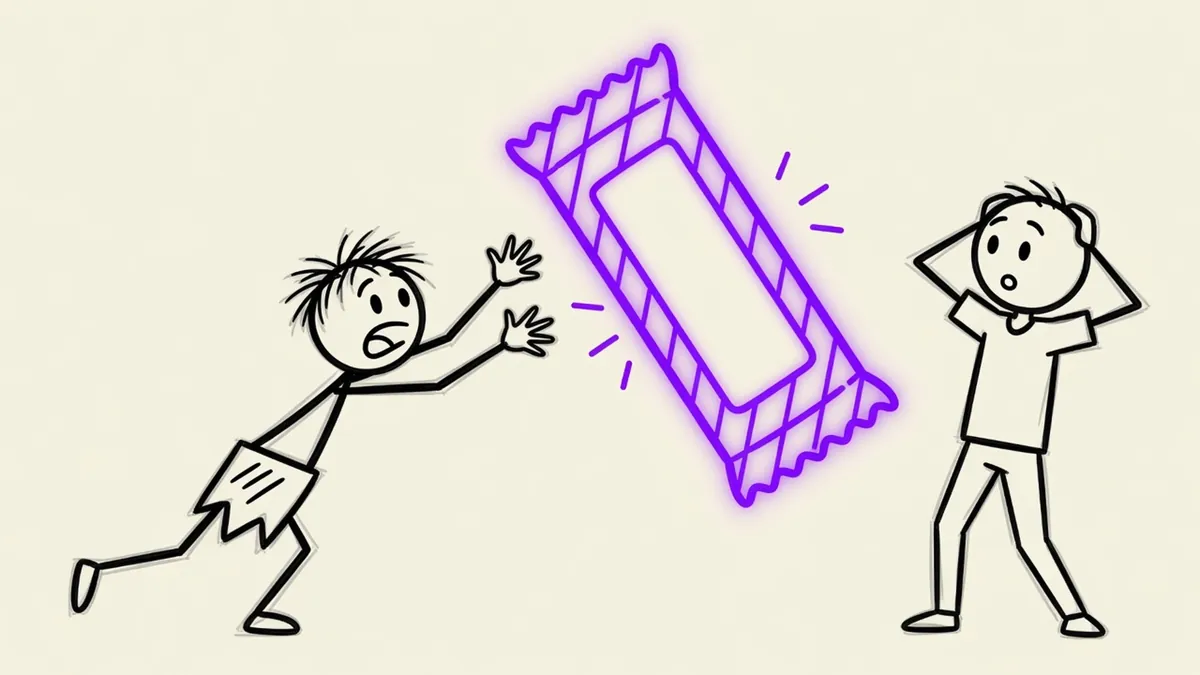
Your ancestors spent roughly two hundred thousand years hungry — not metaphorically, but genuinely foraging for hours a day just to find enough calories to survive to tomorrow. Then you walked into a gas station and bought a candy bar. That mismatch is the whole story. Your brain didn't evolve for aisles stocked with unlimited sugar; it evolved for a world where sweetness was rare and precious. So when you taste something sugary, your nervous system doesn't shrug — it lights up and says find more, now. That's not a character flaw. It's survival software running on obsolete hardware, and it's worth opening the hood.
The hunter-gatherer operating system
On the savanna, every calorie had a cost: you burned energy to find energy. Sweet things — ripe fruit, honey, the occasional root — meant fast fuel, exactly what you needed before something with teeth found you. So evolution wired the brain's reward system to treat sugar like a jackpot. Eat something sweet, dopamine floods the reward circuitry, and your brain stamps a memory: that taste, that place — do it again. In a calorie-scarce world, prioritizing sugar kept you alive. The wiring was never the problem. The problem is that the world changed and the wiring never got the memo.
Dopamine isn't happiness — it's a bounty hunter
People say sugar makes them happy. Biologically, that's not quite right. Dopamine isn't the chemical of pleasure; it's the chemical of pursuit — anticipation and craving, the "go get that again" signal. When you eat a donut, dopamine spikes and then crashes, and your brain reads the crash as "we're running low on the good stuff" and sends you back to the pantry. That's why one cookie becomes three. Your brain isn't weak — it's doing exactly what hundreds of thousands of years of famine trained it to do: grab calories while the opportunity exists. The catch is that today the opportunity is always there.
The fructose blind spot
Not all sugar hits the brain the same way. Glucose — the sugar in bread and rice — eventually triggers fullness signals that tell your brain to stop. But fructose, which dominates soda, candy, and processed snacks, takes a different route: it's largely processed by the liver and doesn't send the same urgent "stop eating" message back to the brain. The result is that you can drink a forty-ounce soda — hundreds of empty calories — and still feel hungry an hour later. Your brain thinks it found a miracle food source while your metabolism quietly pays the bill.
The engineered "bliss point"
Here's the uncomfortable part: modern snacks aren't accidentally irresistible — they're designed that way. The bliss point is the specific ratio of sugar, fat, and salt that maximizes reward without triggering fullness, and it's ordinary product development, not conspiracy. Crunch, melt, sweet hit, salt finish, repeat — every variable tuned so your brain says "more" before your stomach says "enough." Walking a grocery aisle, you're not really choosing food; you're moving through a field of carefully calibrated triggers built by people who understand your reward system extremely well.
Why willpower is the wrong weapon
So why can't you just stop? Because willpower lives in the prefrontal cortex — the slow, rational, easily-tired part of the brain that makes plans at midnight and breaks them at three in the afternoon. Craving lives in older, faster circuits that fire before you finish the thought "I shouldn't." Fighting neurochemistry with guilt is like telling a smoke alarm to be quieter while the kitchen is on fire. The alarm is working correctly. The kitchen is the problem — so change the kitchen.
The reset: work with the hardware, not against it
You don't need to quit sugar forever. You need to stop letting a famine-era brain run a modern supermarket. Three moves that work with your biology:
- Add friction. If the cookies are on the counter, you'll eat them — not because you're broken, but because your brain is efficient. Move temptation off your default path.
- Pair sugar with protein or fiber. A handful of almonds before the candy bar slows how fast glucose hits your bloodstream, and softens the crash that drives the next craving.
- Sleep. Sleep deprivation raises ghrelin (your hunger hormone) and dulls the prefrontal cortex that says no. The cheapest sugar fix is eight hours in bed.
So the next time you finish a bag of gummy bears and feel guilty, remember: your brain isn't broken. It's a two-hundred-thousand-year-old survival machine standing inside a twenty-first-century candy factory. The sugar trap is real — but now you know where the tripwire is.
Wonders of Everything — stickman science deep dives into the hidden wonders of your daily life. Educational overview, not medical or dietary advice.