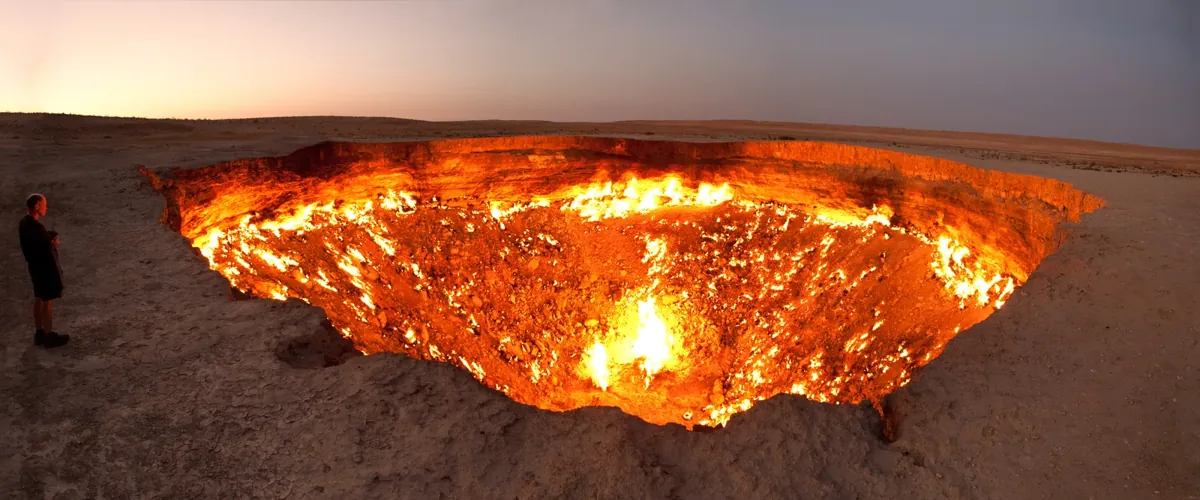
In the heart of the Karakum Desert in Turkmenistan, near the remote village of Derweze, lies a gaping desert crater 70 meters (230 feet) wide and 30 meters deep. Inside, hundreds of roaring natural gas flames illuminate the desert night, emitting intense heat and a deep sulfurous rumble visible for miles. Known around the world as the **Door to Hell** or the Darvaza Gas Crater, this fiery pit has been burning continuously for over five decades.
The 1971 Industrial Accident
Unlike natural volcanic craters, the Darvaza crater was created by a combination of industrial exploration and geological instability. In 1971, Soviet engineers were drilling for oil reserves in the Karakum Desert when their rig unexpectedly struck a cavernous underground natural gas pocket.
The ground beneath the heavy drilling rig collapsed, swallowing the equipment into a wide crater. Fearing that toxic methane gas escaping from the hole would poison nearby villages and wildlife, engineers decided to set the gas on fire, expecting it to burn out in a few weeks. More than 50 years later, the massive subterranean natural gas reservoir continues to fuel the flames.
Extremophile Discoveries in the Pit
In 2013, Canadian explorer George Kourounis became the first person to descend to the bottom of the crater inside a heat-resistant Kevlar suit. Collecting soil samples from the inferno floor, Kourounis and a team of microbiologists discovered several previously unknown species of extremophile bacteria thriving in the high-temperature, methane-rich soil—proving that life can adapt to extreme environment even inside an industrial fire pit.
Scientific References and Sources
- National Geographic. First Expedition to the 'Door to Hell'. NationalGeographic.com (2014).
- Kourounis, George. Extreme Exploration of the Darvaza Gas Crater. Royal Canadian Geographical Society (2014).