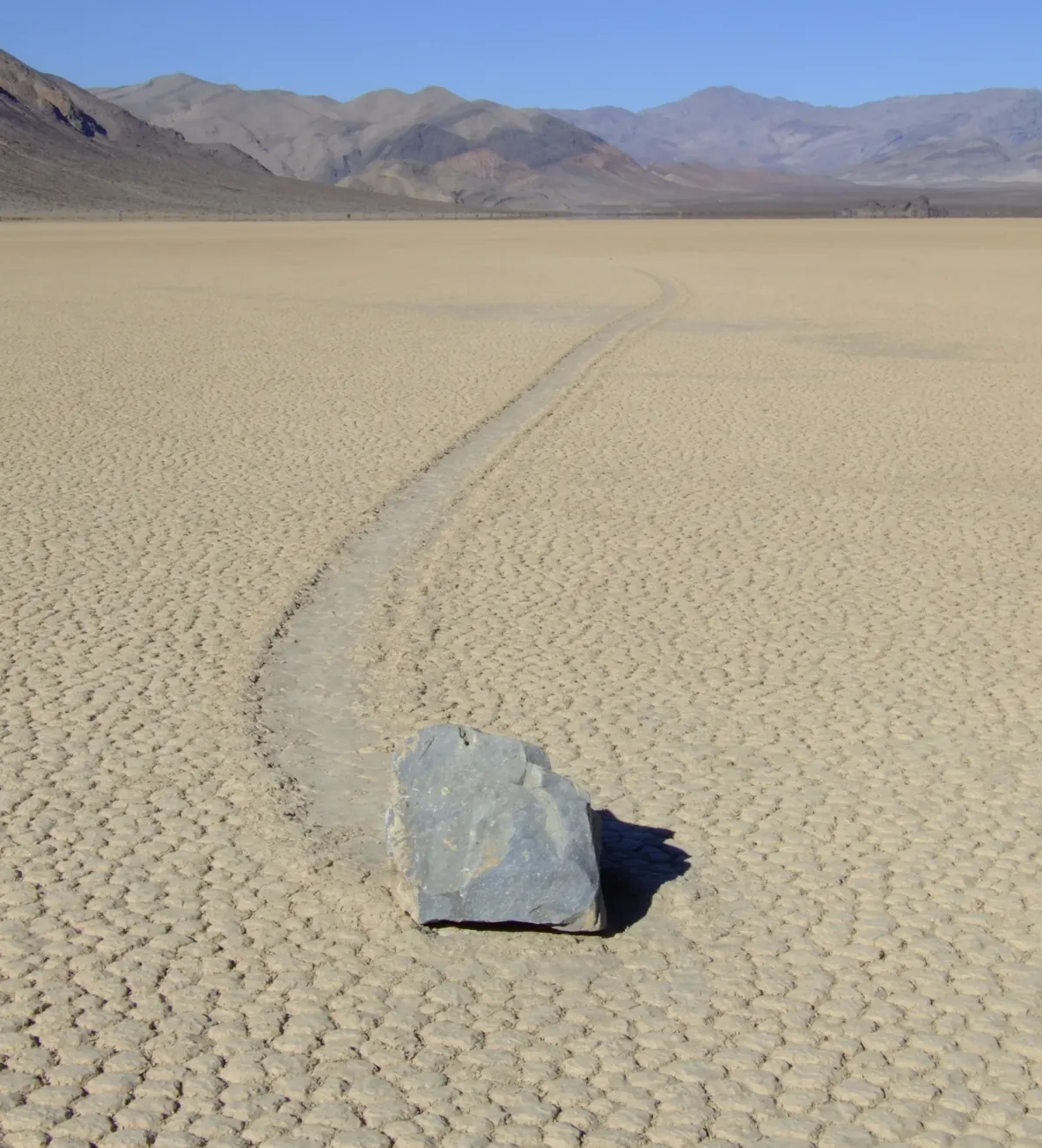
On Racetrack Playa, a dry lake bed located in the remote desert mountains of Death Valley National Park, California, a baffling geological mystery persisted for nearly a century. Heavy dolomite and mudstone rocks—some weighing up to 300 kilograms (700 pounds)—gradually moved across the completely flat desert floor, carving long, winding trails hundreds of meters long behind them. Yet, no one had ever witnessed them moving in real time.
Wild Theories vs. Scientific Investigation
Since the first scientific report in 1948, the "sailing stones" inspired wild speculations, ranging from magnetic anomalies and dust devils to hurricane-force winds and gravity shifts. Early researchers tagged individual rocks with GPS loggers and weather monitoring stations, but for years the stones remained stubborn and stationary.
The 2014 Breakthrough: Ice, Wind, and Water
The mystery was finally solved in December 2013 by oceanographer Dr. Richard Norris and engineer James Norris. Through a rare confluence of winter weather events, the researchers captured the movement on camera and logged precise GPS data:
- Rare Rain: Rain creates a shallow pool of water on the dry playa floor.
- Freezing Temperatures: Overnight winter temperatures drop below freezing, forming a thin sheet of "windowpane" ice (2 to 5 millimeters thick) across the water.
- Sunlight and Wind: During the warm morning sun, the ice sheet cracks into large floating panels. Soft, light breezes (around 10 mph) push the massive ice sheets across the shallow water layer.
- The Dragging Motion: The floating ice sheets push the heavy stones along the muddy lake bottom at speeds of 2 to 5 meters per minute, sculpting smooth furrows in the mud that dry into permanent tracks when the water evaporates.
Scientific References and Sources
- Norris, R. D., et al. Sliding Rocks on Racetrack Playa, Death Valley National Park: First Observation of Rocks in Motion. PLOS ONE 9.8 (2014): e105948.
- Sharp, R. P., and Carey, D. L. Sliding Stones, Racetrack Playa, California. Geological Society of America Bulletin (1976).