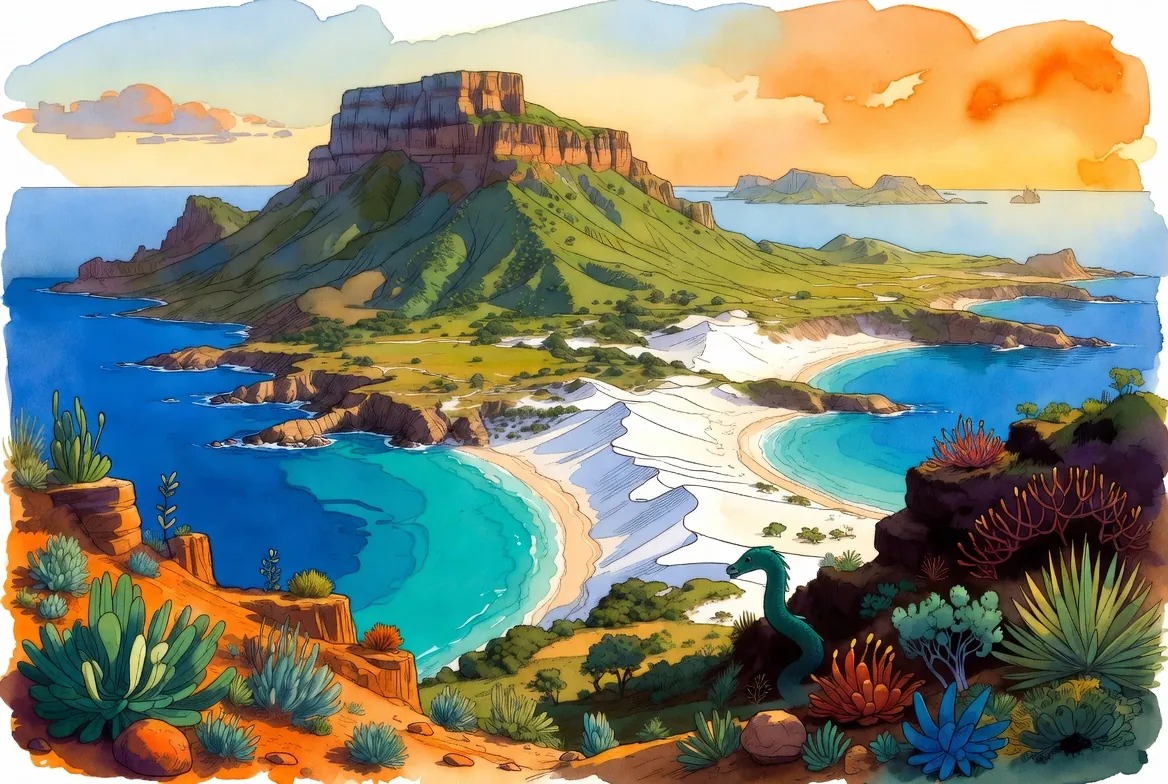
There is an island on Earth that looks like a software rendering error—a place where the rules of botany and landscape design were replaced by something completely foreign. Located in the Arabian Sea, isolated by violent winds, deep oceans, and geopolitics, sits the archipelago of Socotra. With its umbrella-shaped forests, desert roses growing like prehistoric sculptures out of bare rock, and white sand dunes spilling directly into turquoise waters, it is a landscape that feels borrowed from science fiction. But Socotra is not a fantasy; it is a real, living, and highly vulnerable evolutionary archive.
A Fragment of Ancient Gondwana
Socotra's bizarre appearance is the direct result of tectonic separation and millions of years of isolation. Geologically, Socotra is not volcanic like the Hawaiian islands or the Galápagos. Instead, it is a continental fragment. Around twenty million years ago, during the Miocene epoch, the tectonic plates shifted, separating this chunk of land from the southern edge of the Arabian Peninsula and the Horn of Africa.
When an ecosystem is isolated for that long, evolution begins solving the basic problems of life—water storage, defense against heat, and reproduction—in ways found nowhere else. Over 37% of Socotra’s 825 plant species, 90% of its reptile species, and 95% of its land snail species are endemic, meaning they exist only on this small cluster of islands.
The Tree That Bleeds: The Dragon's Blood
The most famous symbol of Socotra is the **Dragon's Blood Tree** (Dracaena cinnabari). From a distance, these trees look like giant green mushrooms or inside-out umbrellas growing out of the arid plateau. This shape is not an aesthetic accident; it is a highly evolved survival mechanism.
Socotra receives very little rainfall. The dense, flat canopy of the Dragon's Blood Tree acts as a giant umbrella, capturing moisture from the seasonal morning mists and directing it down the branches to the trunk and root system. The shade created by the canopy also prevents evaporation, allowing grass and seedlings to survive in the cool soil underneath. When the bark is cut, the tree secretes a thick, dark red resin. Historically traded across the Roman, Greek, and Arab empires, this "dragon's blood" was prized as a medicine, dye, varnish, and pigment for medieval alchemy.
Survival in Stone: Bottle Trees and Desert Roses
On the rocky plateaus and limestone cliffs of Socotra, plants have evolved to store water like living tanks. The **Socotran Bottle Tree** (Adenium obeisum subsp. socotranum) and the **Desert Rose** feature massive, bulbous trunks that store water through the intense dry seasons. Their trunks are covered in a pale, reflective bark that bounces back the scorching sun, keeping the interior fluids cool.
Similarly, the **Cucumber Tree** (Dendrosicyos socotranus) is the only member of the cucumber family (Cucurbitaceae) that grows as a tree, displaying a swollen trunk and sparse, scratchy leaves. These plants resemble botanical sculptures, clinging to sheer stone faces where soil is almost non-existent, illustrating the sheer teimousity of life under pressure.
Beyond the Postcard: A Living Human Landscape
One of the most common mistakes visitors and travel bloggers make is treating Socotra as an empty, forgotten museum of plants. Socotra is home to a human population of over sixty thousand people, with a rich culture, a unique language (Soqotri, an unwritten Semitic language related to ancient South Arabian dialects), and deep pastoral and fishing traditions.
For centuries, the Soqotri people have managed the island's resources through traditional tribal laws that regulate the harvesting of wood, grazing of livestock, and protection of water sources. The island is not a blank canvas of "alien" life; it is a shared home where human survival and ecological preservation are deeply intertwined.
A Fragile Future under Siege
Socotra was declared a UNESCO World Heritage site in 2008, but its unique biodiversity is facing unprecedented threats. The most immediate danger comes from introduced species. Goats, brought to the island by humans, roam the plateaus and eat the slow-growing seedlings of the Dragon's Blood Tree before they can develop bark, threatening to leave a forest of "old giants" with no younger generation to replace them.
Furthermore, climate change has introduced increasingly severe cyclones that strip the plateaus of soil and uproot ancient trees that take centuries to grow. With Yemen's ongoing civil conflict complicating governance, infrastructure development, and conservation funding, the archipelago sits at a delicate crossroads between preservation and irreversible loss.
Bibliographic References
- Cheung, C., & DeVantier, L. (2006) — Socotra: A Natural History of the Islands and their People. Odyssey Books & Guides.
- Maron, J., et al. (2012) — "The conservation status and threats to the endemic flora of the Socotra Archipelago, Yemen." Journal of Arid Environments, 78, 122-131.
- UNESCO World Heritage Centre (2008) — "Socotra Archipelago Advisory Body Evaluation." World Heritage Committee Report.
Wonders Of — exploring the rare, the hidden, and the beautiful stories of our planet.