The Giant Eye in the Desert Visible From Space: The Richat Structure
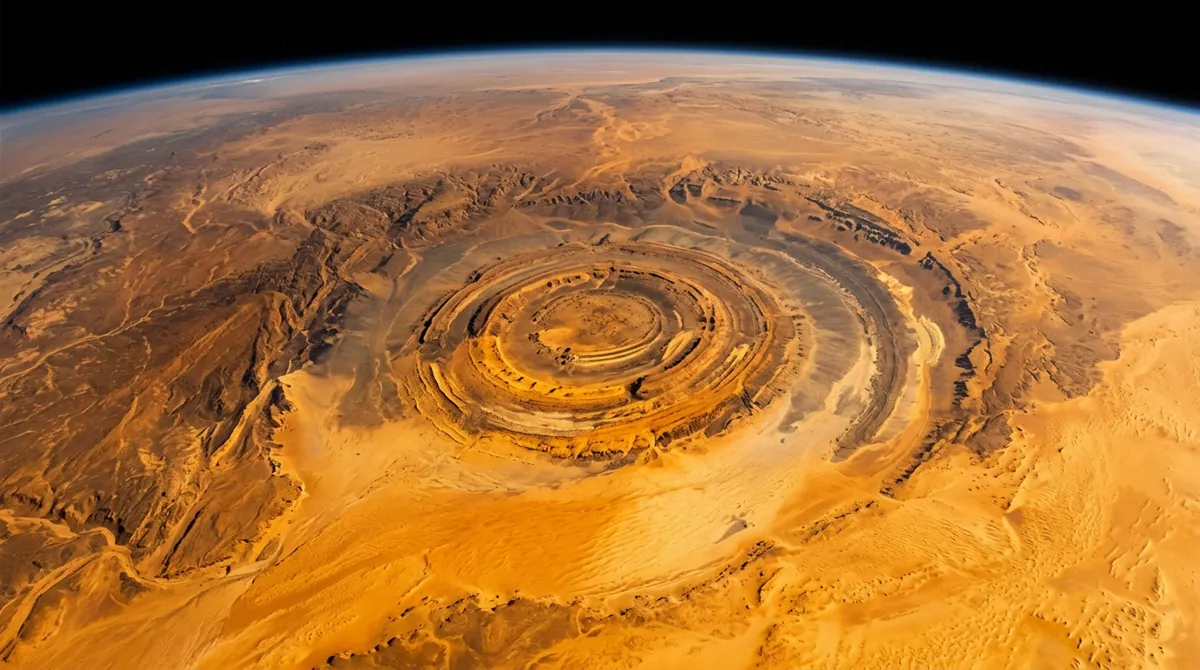
Deep in the Mauritanian desert, there is a giant circular target cêrca of forty kilometers wide. It is so large that it is completely invisible from the ground — observers standing inside it see only flat gravel plains and low hills. In fact, humanity did not even realize this perfect bullseye existed until early astronauts used it as a landmark during Gemini missions in 1965. The official name is the Richat Structure, but the world knows it as the Eye of the Sahara.
For decades, this massive circle has driven scientists mad. What force could carve a series of perfect, concentric rock rings in the middle of a desert? Today, while geologists have solved the mystery, a popular internet theory remains: why does this structure perfectly match Plato’s ancient description of the lost city of Atlantis?
The Atlantis Connection: Plato's Blueprint?
In 360 BC, the Greek philosopher Plato wrote the dialogues Timaeus and Critias, describing a legendary empire called Atlantis. According to Plato, the capital city was built of concentric rings of water and land, measuring exactly 127 stadia across. When converted, this measurement equals cêrca of forty kilometers — the exact diameter of the Eye of the Sahara.
The geographic details continue to align. Plato described Atlantis as bordered by high mountains to the north, with a flat plain opening to the sea to the south. A satellite view of the Richat Structure reveals a mountain ridge on its northern border and dry delta channels opening to the south. Furthermore, geological evidence shows that the Sahara was once green, filled with rivers and lakes, during the African Humid Period. In ancient times, the Atlantic Ocean might have reached the area, making a circular, sea-connected city possible.
It is a compelling theory that has captured the internet's imagination. However, a closer look at the rocks reveals a different story.
Did a Meteor Strike Mauritania?
When geologists first visited the remote Mauritanian desert to study the Eye, their initial hypothesis was a meteor strike. A hypervelocity space rock hitting the Earth millions of years ago would naturally create a circular impact crater.
But the theory was quickly debunked. A meteor strike leaves behind unmistakable fingerprints: shocked quartz, high-pressure silica minerals (like coesite), and shattered impact-melt breccia. Geologists found none of these. The rock layers of the Eye are flat, calm, and undisturbed, with no evidence of the extreme pressure and heat of an extra-terrestrial impact.
The Magma Bubble and 100 Million Years of Erosion
So, if it wasn't a meteor, and it wasn't Atlantis, what created the perfect rings? The answer lies deep underground, dating back cêrca of 100 million years during the Cretaceous period, when the supercontinent Pangaea was tearing apart.
A massive dome of hot magma pushed upward from the Earth's mantle, prying open the sedimentary crust from below like a giant bubble under a carpet. This force lifted the sandstone and limestone layers high into a dome. Crucial to the shape, the magma never actually erupted. It cooled slowly underground, and over millions of years, the rock dome collapsed inward.
Then, the forces of wind and water took over. Over vast geological eras, the elements eroded the structure. Because different types of rock erode at different speeds, the harder quartzite layers resisted the wind, remaining as elevated circular ridges. The softer limestone and shales wore away quickly, forming the concentric circular valleys. The result is a giant geological onion, sliced open by time.
A Remote Natural Laboratory
At the center of the Eye lies a mass of hydrothermal breccia, a rock composed of shattered fragments cemented together by silica. This shows that hot, mineral-rich fluids once boiled at the center during the dome's formation. Today, the Eye is one of the most remote and hostile environments on Earth, with summer temperatures regularly crossing 45 degrees Celsius.
Whether you choose to see the Richat Structure as the mythical ruins of Atlantis or as a spectacular masterpiece of natural erosion, the Eye of the Sahara remains one of the most astonishing wonders of our planet's crust — a giant target reminding us of the complex forces that shape the ground beneath our feet.
Sources and References
- NASA Earth Observatory, satellite imagery and astronauts logs of the Gemini and Apollo missions.
- Guillaume, S., et al. The Richat Structure (Sahara of Mauritania): An eroded Cretaceous alkaline dome. 2005.
- Dietz, R. S., et al. Richat and Semsiyat Domes, Mauritania: Not Astroblemes. Geological Society of America Bulletin, 1969.
- Plato. Timaeus and Critias. (Classical Greek translations on Atlantis).
Method note: Diameters and topography are verified via USGS digital elevation models. The geological consensus rests on the lack of shocked quartz, proving a volcanic and erosional origin rather than impact or artificial construction.