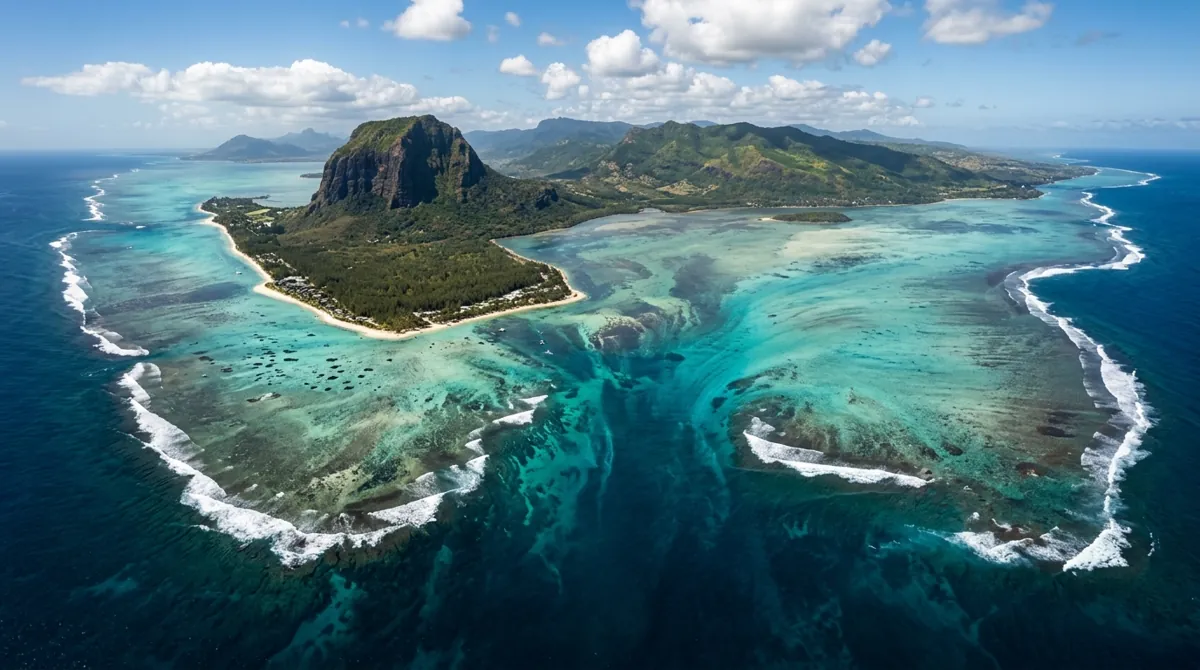
In the Indian Ocean, there is a place where the sea appears to open up.
A massive waterfall.
Plunging directly into the ocean.
Down into a dark, endless abyss.
From above, it looks like a scene from a nightmare.
An underwater vortex.
Swallowing the sea itself.
But if you swim there, you will not drown.
This is the island of Mauritius.
A tropical paradise off the coast of East Africa.
Famous for its white beaches.
And turquoise lagoons.
But at the southwest corner, the calm water hides a terrifying view.
A dramatic cliff under the surface.
The "underwater waterfall".
Visible only from the air.
If you stand on the beach, the water looks calm.
If you swim in the lagoon, the surface is still.
But from a helicopter, the illusion is complete.
A giant canyon opening in the ocean floor.
To understand it, we have to look at how the island was born.
Mauritius is relatively young.
Formed by volcanic eruptions millions of years ago.
It rests on a massive underwater shelf.
Known as the Mascarene Plateau.
Around the island, the water is shallow.
Only ten to thirty meters deep.
A turquoise playground of coral reefs.
But just past the edge of the reef, the shelf ends.
It drops off.
Abruptly.
Down into the deep oceanic trench.
The drop-off is sudden.
Falling to a depth of over four thousand meters.
That is more than two miles straight down.
But the water is not falling.
The ocean itself is not draining.
What we are seeing is sand.
The island is constantly eroding.
Waves crash against the beaches.
Ocean currents sweep across the shallow volcanic shelf.
They carry silt and sand along the seabed.
Pushing it toward the southwest edge.
When the sand reaches the drop-off, gravity takes over.
The sand cascades down the steep underwater cliff.
It is a waterfall of sand, not water.
A river of sediment pouring into the abyss.
The movement is continuous.
Like a slow-motion avalanche under the sea.
The sand slides down the slope and disappears into the dark.
The colors make the trick work.
Shallow turquoise water reflects the light.
While the deep ocean absorbs it, looking almost black.
The light sand sliding down the dark slope creates the illusion of rushing foam.
It looks like water because we see the flow.
Mauritius is slowly washing away.
Returning its sand back to the deep ocean floor.
Nature is a master of illusion.
And the waterfall is its greatest painting.
If you want to discover how Earth is stranger and smarter than fiction, subscribe to Wonders Everything. Next, we travel to the silent, moving rocks of a dry desert lakebed. ---