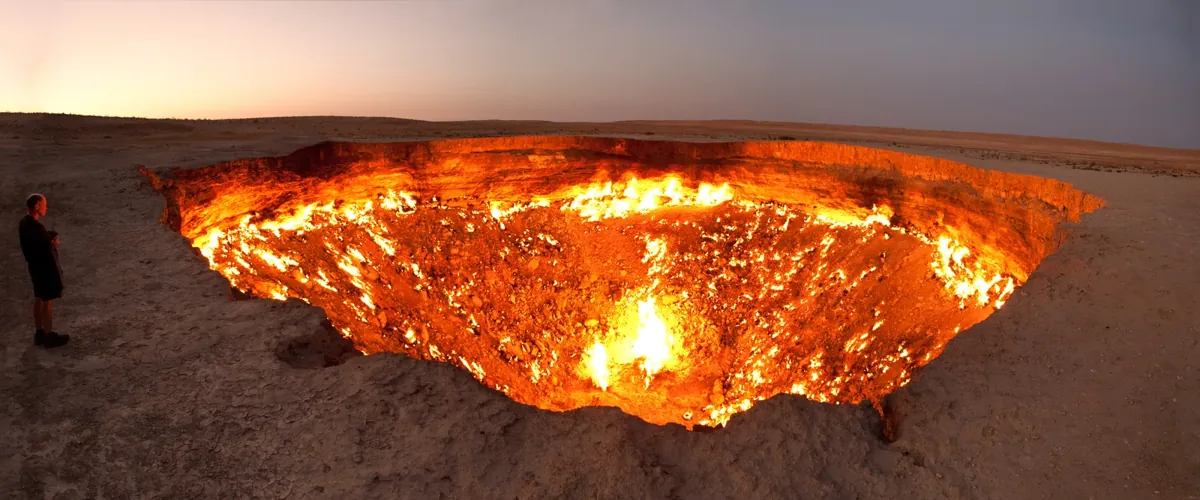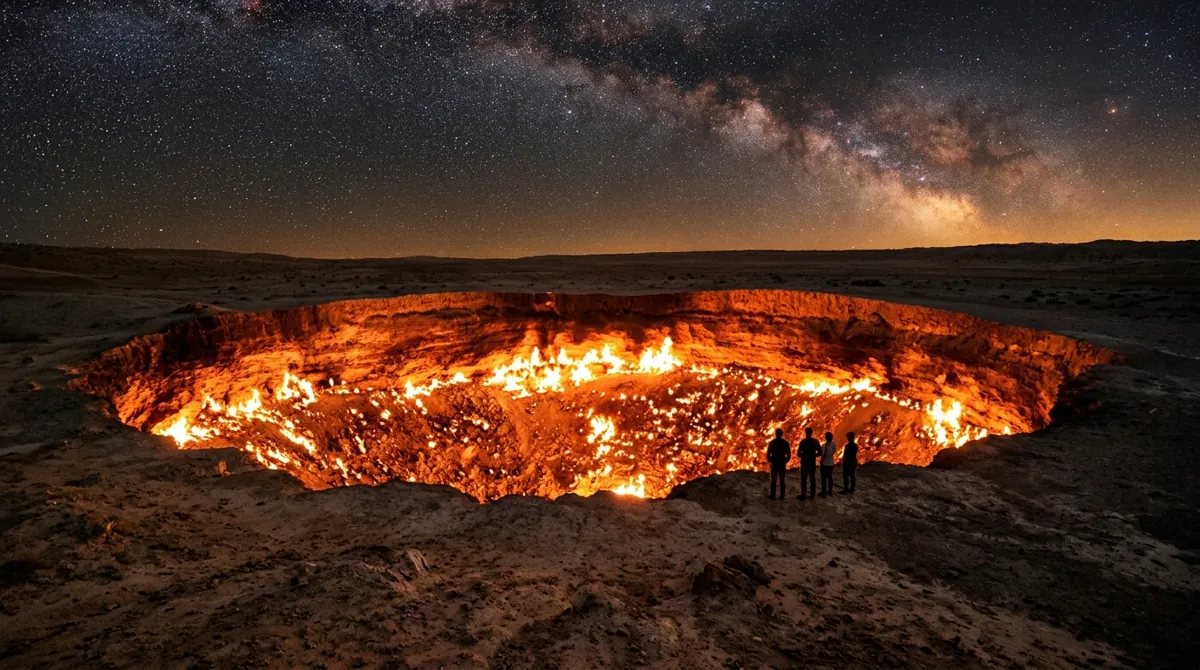
In the middle of a desert, there is a hole that looks like it leads underground.
Not a cave.
Not a volcano.
A burning crater.
At night, it glows so fiercely that people call it the Door to Hell.
And for decades, it would not stop burning.
This is the Darvaza gas crater.
A fiery pit in Turkmenistan’s Karakum Desert.
Around it, there is sand, silence, and open sky.
Inside it, hundreds of flames have burned across a collapsed field of natural gas.
From the rim, the crater looks alive.
Fire crawls across the floor.
Heat rises in waves.
The desert air flickers.
And the whole place feels like Earth accidentally opened a furnace.
The common origin story begins in the Soviet era.
Geologists were searching for oil or gas in the desert.
Then the ground collapsed.
A drilling site dropped into an underground cavern filled with natural gas.
That left behind a wide crater.
And gas kept escaping from below.
The most repeated account says engineers set it on fire.
The idea was simple: burn off the gas, instead of letting dangerous fumes spread.
They expected the fire to die in days.
But the desert had other plans.
Days became weeks.
Weeks became years.
Years became decades.
And the crater became one of the strangest landmarks on Earth.
But here is the part that makes it even stranger.
The exact early history is not perfectly clear.
Some records are missing, classified, or hard to access.
Some accounts place the collapse in 1971.
Others suggest the timeline may be more complicated.
So the Door to Hell is not just a fire.
It is also a mystery with incomplete paperwork.
What is not mysterious is the fuel.
Natural gas.
Especially methane.
Methane is powerful.
It burns easily.
And if it escapes unburned, it is also a strong greenhouse gas.
That is why the crater is more than a tourist attraction.
It is beautiful, dangerous, and environmentally complicated.
For years, travelers crossed the Karakum Desert to see it at night.
They camped near the glow.
They watched flames move inside the earth.
They photographed a place that looked impossible.
But Turkmenistan has also considered closing it.
Officials have cited health, environmental, and natural gas concerns.
In recent years, reports have suggested that the fire has been reduced.
Some accounts describe fewer flames and a weaker glow than before.
But that does not make the story simple.
If less gas burns, more methane may escape directly.
So even a fading fire can raise new questions.
That is the strange lesson of Darvaza.
A place can be spectacular and troubling at the same time.
It can pull tourists toward the flames...
while reminding us that the ground beneath our feet is never as quiet as it seems.
The Door to Hell is not magic. It is geology, gas, fire, and a human mistake that the desert refused to forget. ---