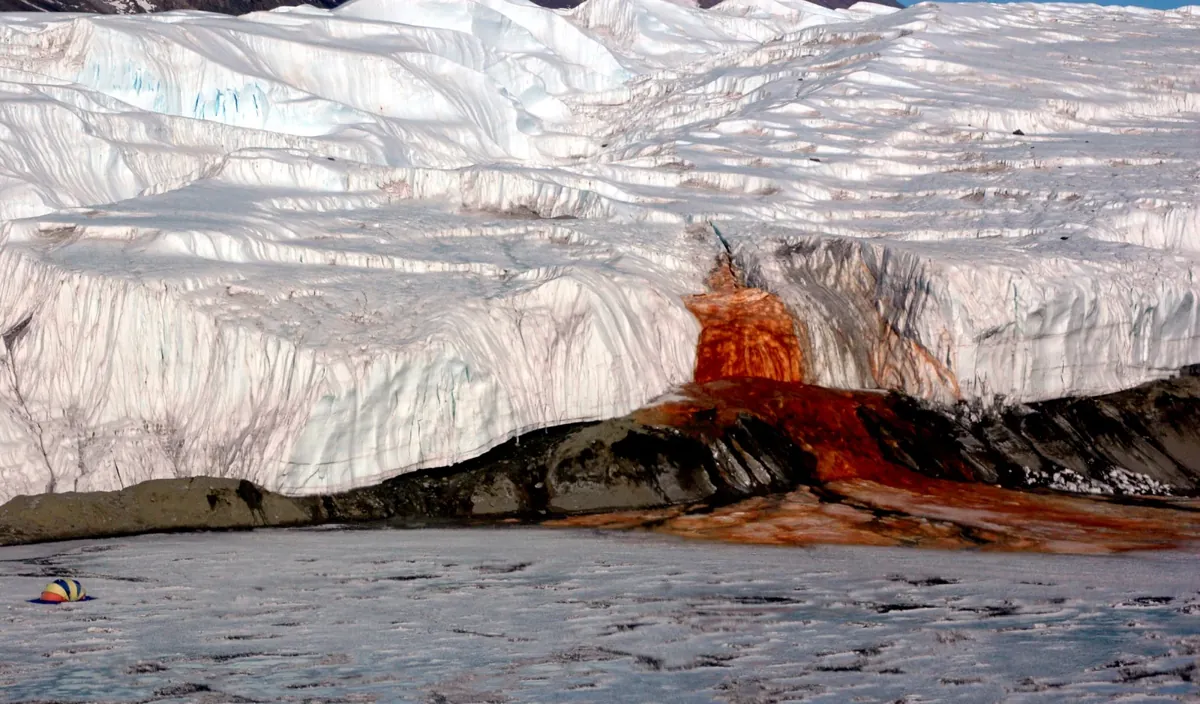
Deep within the frozen expanse of Victoria Land in East Antarctica lies the McMurdo Dry Valleys—one of the most extreme desert environments on Earth. Here, where snow rarely falls and temperatures drop far below freezing, a five-story waterfall of blood-red water pours slowly from the snout of Taylor Glacier into the ice-covered surface of Lake Bonney. Known as Blood Falls, this eerie geological anomaly puzzled scientists for over a century after its discovery by Australian geologist Griffith Taylor in 1911.
The Discovery and Initial Hypotheses
When Griffith Taylor first documented the crimson waterfall during the historic Terra Nova Expedition, he hypothesized that the deep red color was caused by microscopic red algae living inside the glacier ice. However, mid-20th-century chemical analyses disproved the biological theory. The crimson hue was not caused by plant life, but by an extraordinary chemical phenomenon: rich deposits of dissolved iron oxide oxidizing upon contact with atmospheric oxygen.
The Subglacial Time Capsule
Recent radio-echo sounding and electromagetic surveys conducted by researchers at the University of Alaska Fairbanks and Colorado College revealed the true source of Blood Falls. Approximately two million years ago, a hyper-saline fjord was trapped beneath the rising ice of Taylor Glacier. Sealed off from sunlight, oxygen, and atmospheric warmth, this ancient body of water became a subglacial time capsule buried beneath 1,300 feet of solid ice.
The subglacial lake is three times saltier than the ocean, preventing it from freezing even at temperatures of -7 degrees Celsius (19 degrees Fahrenheit). Lacking oxygen and light, an ancient community of extremophile microbes survived for millions of years by metabolizing iron and sulfate ions dissolved from the bedrock—a biological process that operates entirely independently of photosynthesis.
Scientific Significance for Astrobiology
The existence of extremophile life inside Blood Falls has profound implications for astrobiology. Scientists studying planetary geology consider the McMurdo Dry Valleys one of the best terrestrial analogs for Mars and Jupiter's icy moon, Europa. If microbial life can thrive beneath hundreds of meters of Antarctic ice in complete darkness and high salinity, similar life forms could potentially survive inside subglacial oceans on distant worlds.
Scientific References and Sources
- Mikucki, J. A., et al. A Contemporary Microbially Maintained Subglacial Iron World. Science 324.5925 (2009): 397-400.
- Badgeley, J. A., et al. An Origin for Blood Falls, Taylor Glacier, Antarctica. Journal of Glaciology 63.240 (2017): 737-746.
- National Science Foundation (NSF). Unlocking the Secrets of Blood Falls. Antarctic Sun (2017).