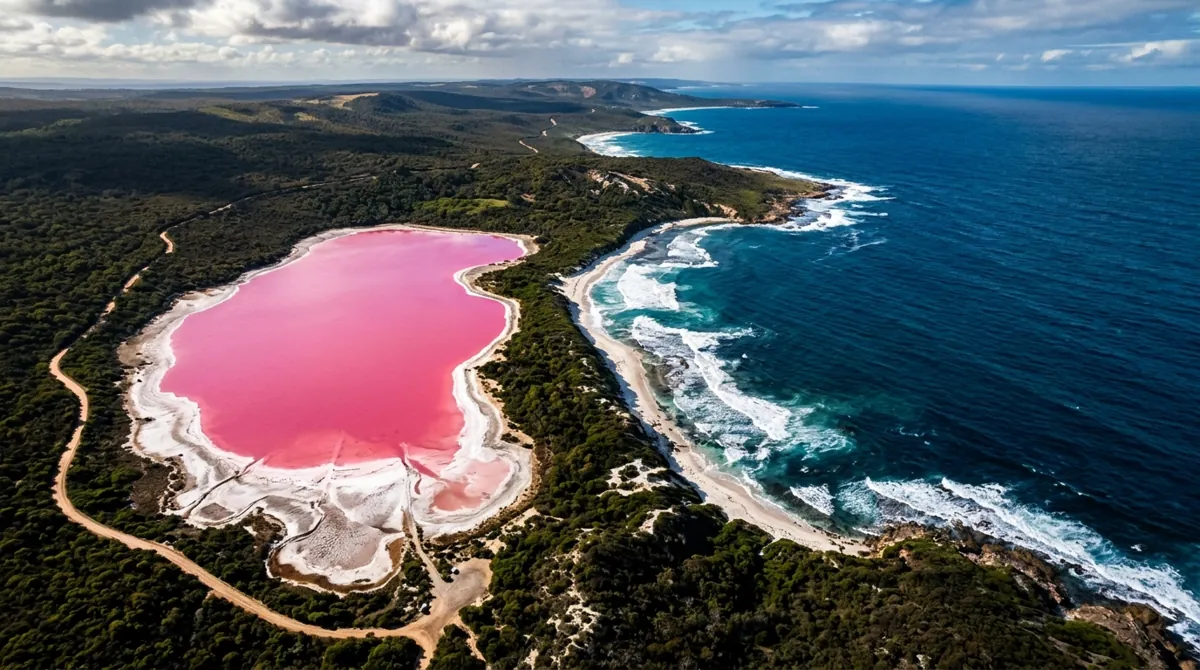
Fly over Middle Island in Western Australia, and you will see a visual shock: a lake the color of bubblegum, bordered by a strip of white sand and deep green eucalyptus forest, sitting right next to the dark blue of the Southern Ocean. This is **Lake Hillier**. To the tourist or the casual Instagram browser, the lake looks photoshopped or dyed. But its surreal pink shade is not an optical illusion, nor is it a chemical spill. It is a biological masterpiece created by some of the most resilient, extreme organisms on our planet.
The Discovery and the Mystery of the Color
Lake Hillier was first documented by British navigator and cartographer Matthew Flinders in 1802. Flinders climbed the island's highest peak and saw "a small lake of a rose colour." For over two centuries, the cause of the color was debated. Some scientists hypothesized that the pink hue was due to minerals in the lake bed, while others thought it was an optical effect of the salt crust reflecting light.
Unlike other pink lakes that change color depending on the temperature or season, the water in Lake Hillier remains bubblegum pink year-round. Even when you scoop the water into a glass bottle, it retains its pink color. In recent years, genetic sequencing has finally solved the mystery, revealing a complex microbial community that thrives where almost nothing else can survive.
The Microscopic Colorists: Dunaliella salina
The primary driver of the pink color is a single-celled microalga called Dunaliella salina. In normal conditions, algae are green due to chlorophyll. However, in environments with extreme salt concentrations (Lake Hillier is roughly ten times saltier than the ocean), most plants would shrivel and die from osmotic pressure.
To survive, Dunaliella salina produces massive amounts of carotenoids, specifically beta-carotene (the same pigment that makes carrots orange). These red-orange pigments act as a natural sunscreen, absorbing blue and ultraviolet light and protecting the cell's DNA from damage under the intense Australian sun. When millions of these cells cluster in the shallow, salty water, they tint the entire lake pink.
The Extreme Bacteria: Halobacteria and Salinibacter ruber
While Dunaliella salina plays a major role, DNA sequencing by the eXtreme Microbiome Project in 2015 revealed that the pink ecosystem is also populated by millions of red bacteria. The most common are **Halobacteria** (or haloarchaea) and **Salinibacter ruber**.
These organisms are "extreme halophiles"—salt-loving microbes that require high concentrations of sodium chloride to grow. They possess specialized red pigments called bacteriorhodopsin to capture light energy for fuel. Together with the beta-carotene from the algae, these bacteria create the deep, stable rose-pink hue that defines the lake.
| Organism Type | Scientific Name | Pigment Produced | Function in Cell |
|---|---|---|---|
| Microalga | Dunaliella salina | Beta-carotene (Red/Orange) | Sunscreen; protects against ultraviolet radiation |
| Archaea | Halobacteria | Bacteriorhodopsin (Red/Purple) | Light-driven proton pump for energy production |
| Bacterium | Salinibacter ruber | Red pigments | Protection and light absorption |
Other Pink Lakes: Hutt Lagoon and Lake Retba
Lake Hillier is not the only pink lake on Earth, though it is the most famous for its stable color. Western Australia's **Hutt Lagoon** is a much larger salt lake that varies from deep red to pink and even purple depending on the time of day, season, and cloud cover. Because of its massive size and high density of Dunaliella salina, Hutt Lagoon is used for commercial farming, harvesting beta-carotene for dietary supplements and natural food coloring.
Similarly, **Lake Retba** (Lac Rose) in Senegal, West Africa, displays a striking pink color that is harvested for salt by local workers who coat their skin with shea butter to protect themselves from the intense salinity.
Can You Swim in a Pink Lake?
The short answer is yes. Despite their unnatural appearance, the pink lakes are completely safe to swim in. The microalgae and bacteria are completely harmless to humans. In fact, due to the high salt concentration, you would float effortlessly on the surface, similar to swimming in the Dead Sea.
However, actually visiting and swimming in Lake Hillier is almost impossible. The island is a protected nature reserve, and tourists can generally only view the pink marvel from scenic flights. This isolation is a blessing, keeping one of Earth's most beautiful biological anomalies pristine and undisturbed.
References and Sources
- Flinders, M. (1814) — A Voyage to Terra Australis. G. and W. Nicol. (First-hand historical record of the discovery).
- Oren, A. (2005) — "A hundred years of Dunaliella research: 1905–2005." Saline Systems, 1, 2.
- eXtreme Microbiome Project (2015) — "Metagenomic Analysis of Lake Hillier, Middle Island, Western Australia." XMP Metagenomics Report.
Wonders Of — uncovering the biology and geology behind Earth's most striking visual phenomena.