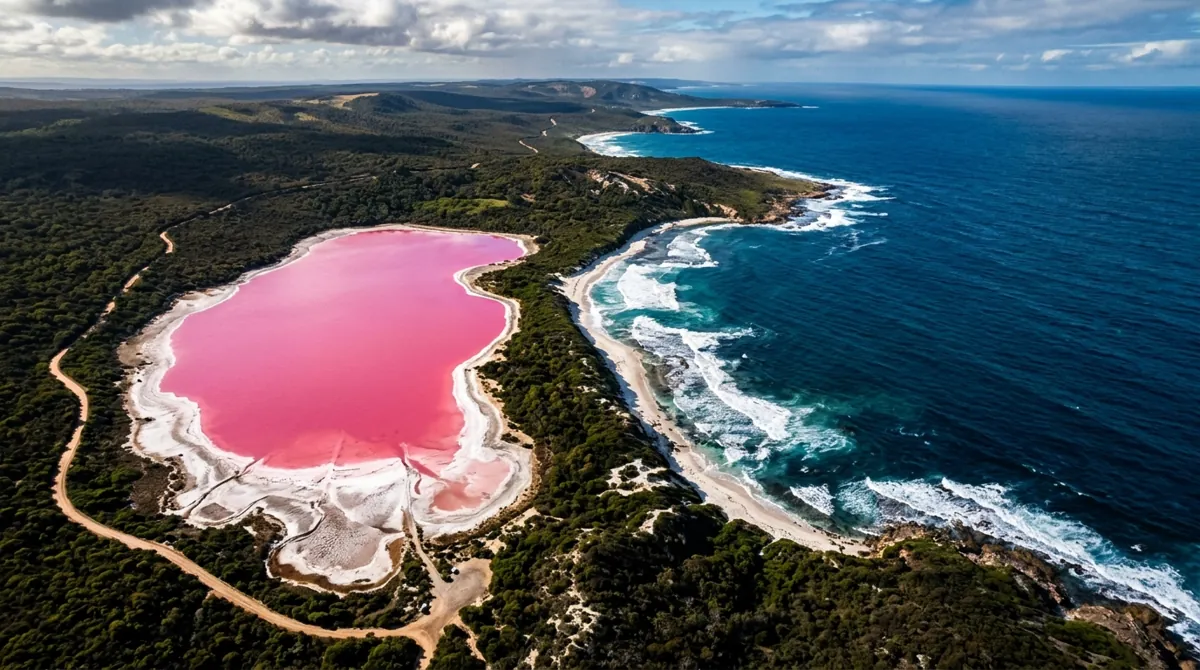
There is an island on Earth that looks like someone rendered it with the wrong planet settings.
Umbrella-shaped trees. White dunes falling into turquoise water. Caves, cliffs, coral reefs, and forests that feel borrowed from another world.
This is Socotra. And its most famous symbol is the dragon's blood tree.
From a distance, these trees look like giant green umbrellas growing out of red stone.
Cut the bark, and the tree can release a dark red resin. For centuries, people called it dragon's blood.
But this tree is not strange for decoration. Its shape helps catch mist, create shade, and protect life beneath it.
Socotra sits in the Arabian Sea, near the mouth of the Gulf of Aden, isolated by water, wind, and time.
When life is cut off for millions of years, it starts solving problems in ways we almost never see anywhere else.
Socotra is not only one island. It is an archipelago: four islands and two rocky islets in the northwest Indian Ocean.
Geologically, Socotra is a continental fragment, tied to the ancient edge of Africa and separated into its own evolutionary theater.
Then there are the bottle trees, with swollen trunks that store water through long dry seasons.
And beneath the surface, limestone caves open like hidden rooms inside the island.
In places like Hoq Cave, Socotra becomes more than a landscape. It becomes an archive of water, stone, and time.
Dragon's blood resin helped make Socotra known far beyond its shores, moving through ancient trade routes as dye, medicine, pigment, and legend.
Look up from below, and a dragon's blood tree can feel like a living cathedral.
The desert rose grows like a sculpture: swollen trunk, pale bark, and flowers that look almost too delicate for such a harsh place.
In the highlands, fog rolls across the plateau, feeding plants that survive where rain can be rare.
At night, Socotra changes again. The coast darkens, the stars open, and the island feels impossibly far from everywhere.
Socotra even has a cucumber tree: thick, pale, swollen, and adapted to drought in a way that seems almost cartoonish.
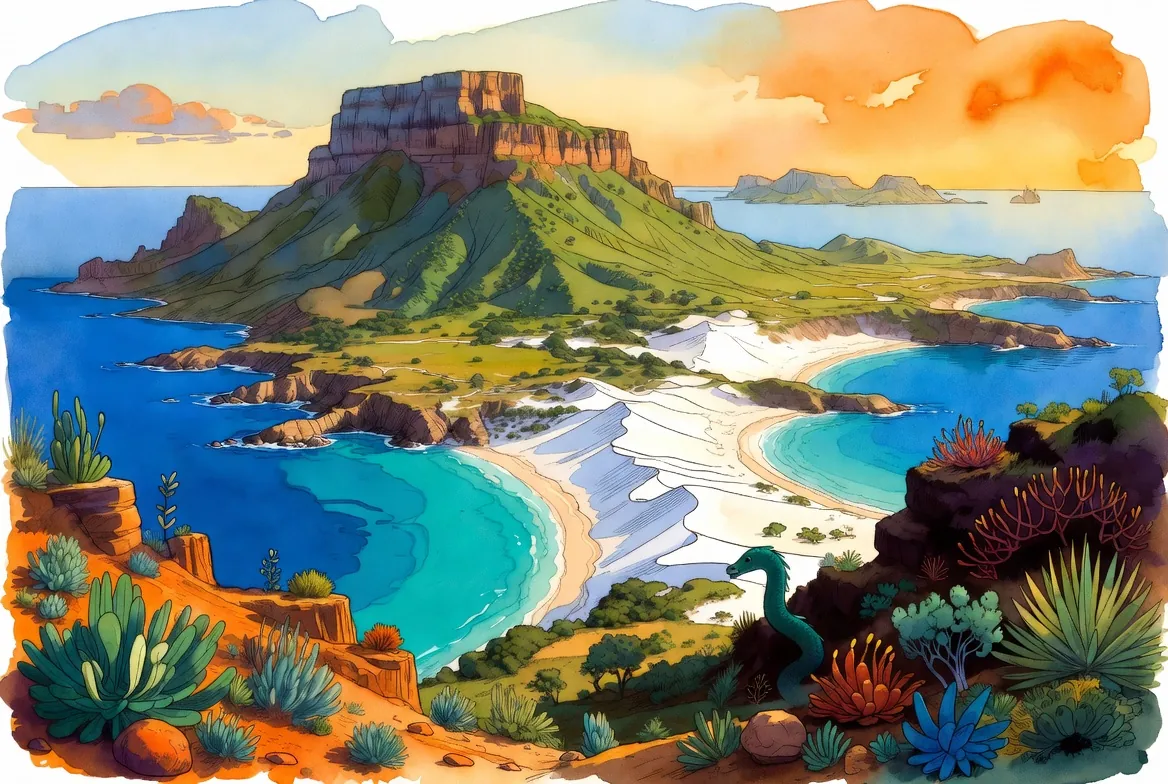
Then the island shifts from alien forest to cinematic coast, where white dunes slide toward blue water.
On isolated cliffs, plants cling to stone, shaped by wind, salt, sun, and the simple pressure to survive.
People call Socotra the Galápagos of the Indian Ocean. But that nickname only gets you halfway there.
Socotra is not an empty fantasy world. People live here, with language, stories, pastoral knowledge, fishing life, and deep ties to the land.
For ancient sailors, Socotra was not just strange. It was valuable, sitting near routes between Africa, Arabia, India, and the Mediterranean world.
When a place looks this unusual, myths follow. Sailors carried stories of impossible trees, rare medicines, and mysterious shores.
But the real island is more interesting than the myth, because the real island is vulnerable.
One of the simplest threats is also one of the hardest. Goats eat young seedlings before the next generation of trees can grow.
Cyclones can tear through landscapes that took centuries to build. A single storm can damage trees older than nations.
And around the coast, fishing is not a postcard. It is work, memory, food, and daily life.
Pastoral life is part of Socotra too. Conservation here is never only about plants. It is also about people and survival.
Some birds here carry Socotra's isolation in their feathers. The island is a refuge written in wings.
The limestone canyons cut through the land like open pages, showing how water and time shaped the island's bones.
Seasonal winds shape everything here: travel, plants, moisture, coastlines, and the rhythm of island life.
Socotra is not only a land wonder. Its reefs and coastal waters make it a biological borderland above and below the sea.
Imagine an ancient camp near the shore: firelight, resin, sailors, stories, and a strange island becoming known across oceans.
For generations, people collected dragon's blood resin carefully, turning a tree's wound into trade, color, medicine, and myth.
A protected seedling may look small, but on Socotra it can mean the difference between a living forest and a museum of old giants.
After a cyclone, the island can look wounded. Branches break, soil moves, and old trees stand like survivors of a battle.
In nurseries, conservationists and local communities try to grow the future one fragile plant at a time.
This is the choice in front of Socotra: a protected living landscape, or a rare world slowly reduced to memory.
Stand under a dragon's blood tree, and the alien feeling changes. It stops feeling alien. It feels like Earth being more creative than we expected.
UNESCO notes that Socotra's marine life is rich too, with coral reefs and coastal fish adding another layer to the wonder.
Above the cliffs, seabirds move between wind and water, linking island, ocean, and sky.
Some of Socotra's most astonishing life is small: reptiles, snails, and quiet creatures that exist nowhere else on Earth.
That is what Socotra really is: a living library, with pages that evolution wrote in isolation.
A tree can survive for centuries and still be threatened by a future it did not evolve to face.
So if Socotra appears online as a bucket-list destination, remember: wonder without responsibility is just consumption with better lighting.
The better kind of wonder asks a different question: how do we make sure this place is still alive after we have seen it?
Researchers can measure species, maps, storms, and seedlings. But local knowledge is part of the island's survival too.
Protection sometimes looks simple: stay on trails, respect rules, limit damage, and remember that fragile places do not recover quickly.
At sunset, Socotra becomes almost impossible again: sand, sea, cliffs, and color folding into one another.
For birds, the island is not just beautiful. It is habitat, resting place, breeding ground, and refuge.
Even the close-up details feel strange: waxy leaves, thick trunks, rough bark, and plants built like survival machines.
A tiny tree on a plateau may not look dramatic. But if it grows, the future of a whole forest grows with it.
From above, Socotra looks like a glowing jewel. But every jewel can crack if handled carelessly.
So the real question is not, 'Can I visit this island?' The better question is, 'How does a wonder survive being discovered?'
At the beginning, Socotra looked like an alien island. By the end, maybe it looks like something even stranger.
A place where ancient trees and new seedlings stand together, asking whether the next century will still have room for them.
Socotra reminds us that Earth still contains places we do not fully understand, places where beauty is not decoration.
It is survival. Subscribe to WondersOf for more stories from the strangest, rarest, most beautiful corners of our world.